Bass Pro Shops Adaptive Product Pages
Helping new and returning customers choose the right gear

Role
Product Designer
Focus Areas
E-Commerce Best Practices, New vs. Repeat Customers, AI Integration
Platform
Mobile & Desktop
Overview
Retail discovery is evolving as shoppers increasingly rely on AI tools, social platforms, and other external sources to research products before visiting retailer websites. By the time they reach a product detail page (PDP), many arrive with specific intent and context, creating an opportunity to move beyond one-size-fits-all PDPs and tailor the experience.
I led a concept exploration for Bass Pro Shops focused on the PDP, examining how it could better support two key scenarios: customers new to a category and returning customers already familiar with it. This included gift buyers as a subset of new customers, who often need additional guidance and reassurance. The project explored a central question: how can PDPs adapt to different levels of familiarity to better guide customers toward purchase?
The Problem
Bass Pro Shops product detail pages largely assume category knowledge, prioritizing specifications over guidance. Modules like “frequently bought together” surface similar products rather than complementary gear, missing opportunities to help shoppers build the right setup. At the same time, Bass Pro has extensive SEO content and customer data that aren’t meaningfully integrated into the PDP experience. The challenge was not simply improving the page, but rethinking how the PDP could use that content and data to better guide shoppers toward the right products.

Research
To better understand how shoppers approach product decisions on Bass Pro Shops, I conducted six user interviews across two groups: customers new to the category and returning customers already familiar with it. New customers included both first-time buyers and gift purchasers without deep product knowledge, while returning customers had prior experience with fishing.
Participants completed a task-based purchase scenario on Bass Pro Shops and answered follow-up questions about their experience. In addition, I conducted a Baymard audit and competitive analysis to evaluate how well the current experience supports purchase decisions.
How Do Different Shoppers Reach a Product Decision?
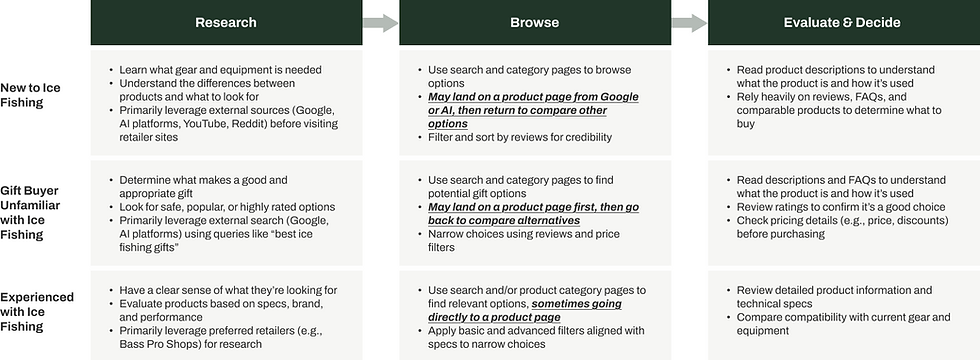
I leveraged interview results to map how different shoppers approach product decisions across research, browsing, and evaluation. Across all groups, AI emerged as a common research tool alongside sources like Google and YouTube. While the overall flow was similar, users relied on the product detail page differently depending on their familiarity with the category—whether to understand the product, compare options, or confirm details before purchasing.
With more entry points into the experience, including AI-driven searches, users increasingly land directly on product pages and move between PDPs and product listing pages as they evaluate options. This reinforces the PDP as the most critical moment in the journey, as it needs to support varying levels of familiarity and decision-making needs.
Journey Comparison
.png)
How Well Do Product Pages Support Purchase Decisions?
I conducted a high-level audit of Bass Pro Shops’ product detail pages using Baymard’s eCommerce best practice guidelines to evaluate how well the experience supports purchase decisions. While the PDP includes key elements like images, specifications, reviews, and recommendations, these are presented in isolation rather than working together to help shoppers choose. Product descriptions and specs are dense and hard to scan, reviews lack strong filtering or summarization, and “frequently bought together” often surfaces similar products instead of complementary gear.
The same page structure is used across product categories, even when some products require more explanation or guidance, making it harder for shoppers to interpret information, compare options, and make confident decisions.
Baymard PDP Audit Preview

How Do Product Pages Compare to Competitors?
I conducted a competitive analysis of product detail pages across Dick’s Sporting Goods, Scheels, REI, Backcountry, and Amazon to evaluate how effectively each experience supports purchase decisions relative to Bass Pro Shops. Effectiveness varied by retailer and by feature. REI and Backcountry do a better job structuring content and providing product education, while Amazon and Dick’s make reviews, ratings, and comparisons easier to use. Several retailers also tailor their product pages by category to better support key purchase decisions, and most allow users to select their fulfillment method directly on the product page.
Compared to these approaches, Bass Pro Shops includes many of the same elements, but they’re harder to scan and compare. The same page structure is used across product categories, even when the information needs are different, and key actions like selecting fulfillment aren’t surfaced on the PDP, which adds extra steps before purchasing.
Competitor Analysis Preview

Key Insights

The PDP Should Support Decisions, Not Just Inform.
Bass Pro's PDP includes key elements like specs, reviews, and recommendations, but falls short of e-commerce best practices for decision-making, making it harder to scan, compare options, and choose the right setup.

The PDP Must Adapt to Different Levels of Customer Familiarity.
New customers rely on the PDP to understand products and need more guidance, while repeat customers use it to quickly compare or confirm details. A single, static page structure creates friction for both.

The PDP Should Account for How Customers Arrive.
Shoppers increasingly land on PDPs from AI tools, search, and external sources with specific intent, but the experience doesn’t reflect that context, missing an opportunity to tailor content and guidance.
Strategy & Design
Research insights informed the design strategy, focusing on three priorities: aligning the PDP with e-commerce best practices, adapting key moments based on customer familiarity, and exploring how AI can further tailor the experience. These priorities guided how information is structured, how users interact with the page, and how the PDP supports different paths to purchase.
E-Commerce Best Practices
The original PDP was functional but did not align with e-commerce best practices for supporting how people shop. It leaned heavily on specs, buried key decision-making content, and treated all users the same regardless of experience level. I restructured the page to better support product understanding, decision-making, and add-to-cart behavior. The desktop and mobile redesigns are provided below with detailed explanations of key ares of changes proceededing them. Select them to view the full redesign.
The desktop and mobile redesigns are shown below, with detailed explanations of key areas of change preceding them. Select each image to view the full redesign.
Desktop (Full Design)

Mobile (Full Design)

Product Details
Improved scannability
Product details and specs were long-form and hard to digest. I moved them into an accordion to reduce overload and brought Questions & Answers into the same section to keep all product-specific information in one place.
Product Overview & Selection
Clarified purchase context
Fulfillment options weren't available until the cart. I added fulfillment selectors directly on the PDP to eliminate friction. I also surfaced key details like return policy and free shipping to support decisions upfront.
Cross-Selling
Made more relevant & actionable
Cross-sell relied on static carousels with limited context. I introduced dynamic modules that adapt based on whether a user is new to the category or more familiar, which is explained in the following section. For Similar Items, I replaced the desktop carousel with a “load more” pattern to encourage deeper engagement. I also added a Related Categories section to help users explore adjacent categories, especially when landing directly on a PDP from an external source.
Reviews
Increased visibility & usability
Reviews were hidden in an accordion. I made them visible by default, added quick-scan elements and “recommended” stats, and introduced search and filters. I also prioritized ratings and detailed feedback over less useful metadata, like the reviewer's name.
Expert Guidance
Introduced contextual support
There was no support on PDP for users who needed help, increasing the risk for site abandonment. I added “Need Help Choosing the Right Gear?”, which opens a dynamic side panel (explained in the next section) and is placed to be visible without distracting from selection.
Design & Accessibility
Enhanced clarity & inclusivity
The page felt dense and lacked accessible contrast. I added more white space, increased image size, updated button colors to meet accessibility standards, and improved touch targets, including mobile image thumbnails.
New vs. Repeat Customers
Rather than redesigning the entire PDP, I focused on adapting key modules based on customer familiarity. New customers need guidance and reassurance, while repeat customers prioritize speed and efficiency. Two areas of the PDP shift to support these different behaviors.
Cross-Sell Module
The cross-sell module changes based on the user. For new customers, it appears as Frequently Bought Together, presenting a curated bundle that helps them understand what they need and how products work together, with combined pricing and a single add-to-cart action to reduce decision fatigue.
For repeat customers, this shifts to Compatible Gear, surfacing a broader set of relevant products in a more flexible, browsable format. Tabbed categories allow recommendations to be more targeted and relevant, rather than a broad set of generic suggestions that are easy to overlook. Because these users are more familiar with the category, they can quickly scan and select the specific items they need without feeling overwhelmed.
New Users

Repeat Users

Get Help from a Bass Pro Expert Panel
On competitor sites, expert guidance is typically placed further down the page, where it can be easily overlooked and is removed from key decision moments. I introduced a “Need Help Choosing the Right Gear?” entry point directly within the PDP to make support more visible at the point of decision.
The panel surfaces Bass Pro’s existing SEO content, which adapts based on the user. For new customers, it highlights more general, educational articles, such as how to choose the right reel or gift ideas for new anglers. For repeat customers, it shifts to more advanced content, including guidance from experienced or well-known fishermen.
It also incorporates location-based content, such as recommended fishing destinations, allowing articles to be tailored based on where the user is located.
New Users

Repeat Users

AI Integration
Bass Pro had already begun incorporating AI into reviews, but I elevated this by surfacing key insights more prominently and making them easier to scan, helping users quickly understand common themes and sentiment. Building on this foundation, I explored how AI could be further integrated into the PDP to respond to how users arrive and what they’re looking for.
When a user arrives from AI tools or search, the PDP can use that query or referral context to adjust the product title, highlighting the attributes most relevant to their intent. That same context can be used to reorder product details, surfacing the most relevant specs first while keeping the full set of information available below. This ensures users see what matters most immediately, rather than scanning through all specs equally.
Example 1: Product Name Update
The user searches “best rods for beginner ice fishing” in ChatGPT and navigates to a product detail page. The product title dynamically updates to “Arctic Angler Ice Spinning Combo — Beginner Friendly” to reflect the user’s intent and provide immediate context.

Example 2: Product Details Update
The user searches “ice fishing auger for thick ice” on Bass Pro Shops and navigates to a product detail page. The search query is used to identify the most relevant product attributes, so a Highlights section is dynamically introduced at the top of Product Details, surfacing features like high torque performance and durable blades, while the full product details remain unchanged below.

Evaluation & Impact
While this was a concept exploration, the next step would be to validate how these changes impact both customer behavior and business outcomes. This would include looking at overall conversion, as well as comparing conversion between new and returning customers, and whether the cross-sell experience is driving additional purchases.
I would also test key modules like cross-sell, reviews, and expert guidance through A/B testing, and follow up with usability testing to understand how the experience performs across different levels of familiarity. The goal is to confirm the design improves how customers choose and purchase products.